It primarily acts as a measure of their flying experience, having crucial information such as flight hours, type of flight, and role. Such a pilot logbook is even more important for students and newly licensed pilots as it helps in training course requirements, eligibility for certificates and ratings, and career growth.
As a budding pilot, logging time accurately is an art you must master. The key is to know what qualifies as flight hours based on flight type, your training organisation, and your country’s aviation regulations.
Here’s a primer on recording and documenting your pilot logbook entries to ensure you’re doing it right.
What Qualifies as Valid Flight Hours?
According to the ADREP 2000 Taxonomy (PDF) issued by the International Civil Aviation Organization (ICAO), flight time is defined as “the total time from the moment an aeroplane first moves for the purpose of taking off until the moment it finally comes to rest at the end of the flight.” In other words, this means you should log from the time the aircraft reverses to the taxiway to the point when it reaches the arrival gate and shuts off the engine.
The ICAO definition of flight time has been more or less adopted by agencies such as the European Union Aviation Safety Agency (EASA). However, these agencies often have additional definitions such as flight time under Instrument Flight Rules (IFR) and Visual Flight Rules (VFR). As a new pilot, you should apply the rules laid out by your respective aviation regulator. Student pilots should consult their flying instructor (FI) for the right information.
Pilots looking to gain a license or apply to airline job listings can use the following table to understand what counts as valid flight hours. You can follow this as a benchmark to satisfy hour requirements for a commercial pilot license (CPL) and airline transport pilot license (ATPL).
| Serial | Type of pilot experience or training | Valid pilot logbook hours | Remarks |
| 1 | Solo | All of the solo flight time when the pilot is the sole occupant of a flight | A PIC may also log solo flight time as PIC time if they’re a license holder |
| 2 | Pilot in command (PIC) | License holder: All of the flight time during which the pilot is the PIC Applicant for license: All of solo flight time, SPIC time, and PICUS time (if countersigned by an instructor) | A PIC license holder can legally log their solo flight and PICUS time too if needed |
| 3 | Student pilot in command (SPIC) | All of flight time when accompanied by an authorized flying instructor (FI) and who does not influence or control the flight | Applicable only to trainee pilots |
| 4 | Pilot in command under supervision (PICUS) | All of flight time when all the duties and functions were carried out by the pilot without any intervention of the PIC in the interest of safety and provided the method of supervision is acceptable to the competent authority | |
| 5 | Second in command (SIC), co-pilot, or first officer (FO) | All of flight time during which the pilot occupies a pilot seat as co-pilot (right seat) on an aircraft that requires more than one pilot | |
| 6 | Instrument time or instrument approach | All flight time when the pilot operates the aircraft by reference to instruments (simulation or actual) | |
| 7 | Dual instruction or instruction time | All time logged as flight instruction, instrument flight instruction, instrument ground time (if verified by an authorized FI) | This can also be counted as training time |
| 8 | Simulator time | All time logged in a full flight simulator (FFS) with or without supervision | This can also be counted as training time |
| 9 | Flight training device | All time logged in a flight training device (FTD) | This can also be counted as training time |
This table was prepared using Part-FCL rules (PDF) issued by EASA and the Code of Federal Regulations issued by the Federal Aviation Administration (FAA) and summarized by the Cornell Law School.
Please note that valid flight hours may differ depending upon the regulatory body governing your jurisdiction. When in doubt, always consider the entire flight time, i.e., off and on the blocks.
Example of a Pilot Logbook PIC Time
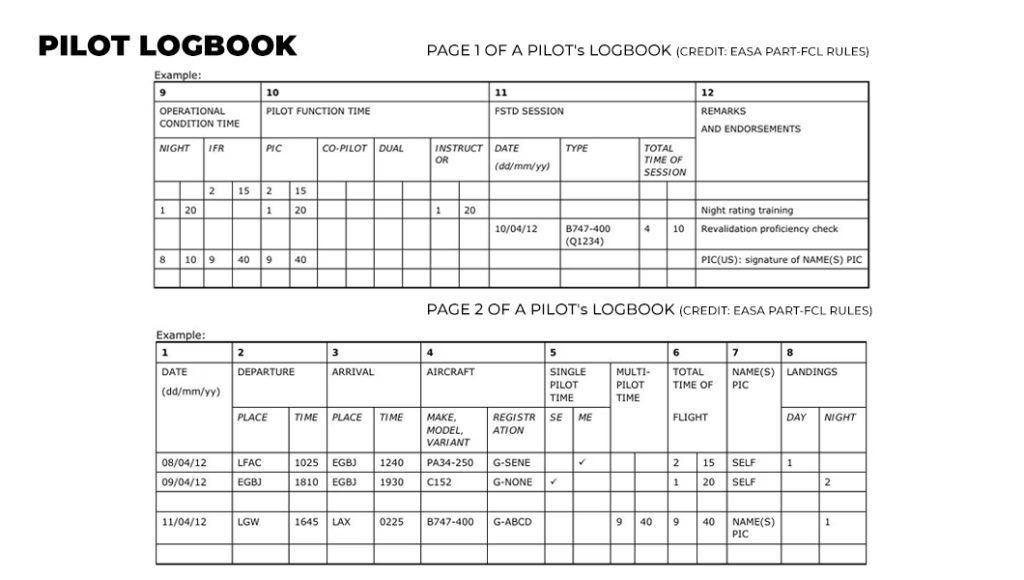
Below are images of a sample entry where a pilot has logged PIC time along with other flight details. In a typical pilot logbook, there are 10-12 columns that are usually printed over two pages.
In the pilot logbook example below, the PIC has logged time for three flights. The valid flight hours are 2 hours 15 minutes, 1 hour 20 minutes, and 9 hours 40 minutes. The fourth entry is an FTSD session.
Note the SE and ME time, number of landings, and remarks. The pilot has also logged night time and IFR time separately in the logbook sample below. This is crucial for pilot currency, where you may need certain night time hours to earn a certificate or rating.
You can use your aircraft’s Hobbs meter or Tachometer to count flight hours. However, using a manual recorder like a watch time to record the “chocks off” and “chocks on” is considered best for accuracy.