

Whether you wish to fly for pleasure or recreational purposes, or build a solid career at an airline, we are here to help you make your dream come true. Follow the steps below to achieve your goal of becoming a pilot.



WHAT ARE THE PERKS of being a pilot?
For many, a pilot career is a dream they have nurtured since childhood. It is no surprise that once you get infected with the passion for aviation, you cannot resist it, and instead turn it into a life-long goal. Indeed, being a pilot is a genuinely meaningful and highly responsible career that will never go out of style, offering you many perks.
Travel for Free
There are few careers where you can expect to travel the world for free and actually get remunerated for doing so. You will quickly see how the list of countries you have visited and people you met is growing, shaping and enriching your life due to the authentic lifestyle you lead as a pilot.
Improve Your Skillset
Pilots work in a very challenging environment, as safety is the top priority in aviation. But the satisfaction that comes from constantly honing your skills in the field you are curious to learn more about is priceless. No two flights will ever be the same, making you improve, gain new experience and be ready to handle the most complex scenarios. And all that, while having the best "office view" one could imagine.
Maintain the Balance
And no, it's not about little time at home and the absence of personal life. Many pilots have found a good balance between their professional and personal life. Instead of working from 9 to 5, you will have a more flexible work schedule and will be able to plan your time off and gatherings with family and friends accordingly.
High & Growing Salaries
Last but not least, pay rates of commercial airline pilots are very high compared to other professions. They typically include notable benefits and grow in line with experience and flown hours. The approximate salary of a First Officer at a regional carrier is €45,000/year and up to €310,000/year of a Captain at a major airline.
Step 1
Determine your purpose and the license you need
If you have a passion and motivation to fly an airplane, your first task is to decide if you want to fly for pleasure and become a private pilot or fly passengers as a commercial pilot. The answer will guide you toward the type of license you should seek.
Step 2
Choose your preferred training program
Once you know your end goal and the type of license you want, you are ready to choose a suitable training program. Below you’ll find a simple overview of type of initial pilot training one can do and licenses they lead to.
PRIVATE PILOT LICENSE – PPL
This license is an introduction to aviation as it entitles you to fly a single-engine piston aircraft (like Cessna, Cirrus, Piper, etc.) privately for non-commercial purposes. It's the foundation where you can build experience and knowledge while traveling on holiday or business trips. Later, you might want to continue your training in general aviation aircraft and obtain additional rating and/or pilot licenses.
Read more about PPLCOMMERCIAL PILOT LICENSE – CPL
This license allows you to be a First Officer on multi-crew air transport aircraft, like Airbus A320 or Boeing 737, and get hired by airlines turning your passion into a career. Gaining a respective Type Rating after receiving the license is necessary to exercise this privilege. The CPL license is sometimes known as a 'frozen' ATPL – there is officially no such license, but it has become a term widely used amongst trainee pilots and is sometimes used in the wider aviation industry. BAA Training offers many training routes to obtain a CPL license described below.
ATPL INTEGRATED TRAINING PROGRAM
The integrated way is the best choice for those who aim to get a license as quickly as possible. You will undergo uninterrupted and highly intense learning, which will take just 16 months to complete. An all-in-one training set, including Type Rating, Base training, and accommodation (optional) is also available.
Read more about our ATPL Integrated programCPL MODULAR TRAINING PROGRAM
The modular route offers greater flexibility than the integrated one as the training is completed in chunks (modules) with breaks in between, leaving room for planning your time and finances. For example, you might manage to combine it with a part-time job and decide to pay in installments instead of one upfront fee. However, the total training duration, in this case, will be longer.
CADET PROGRAMS
These are training programs offered by a pilot training organization with a specific airline, resulting in a conditional job guarantee. Upon enrolment in the program, cadets receive a letter of engagement from the airline, which stands for its intention to hire them, subject to complying with the requirements, such as an excellent academic record and medical fitness. The training is structured exactly the same as ATPL Integrated, except that it includes Type Rating and a conditional job guarantee.
Read more about our Cadet programsATPL THEORY
It is the right course for licensed pilots (holding a PPL or CPL) who plan to work for an airline but have no record of an ATPL theory completion. It is needed for applying for Type Rating and then becoming a First Officer at an airline and stays frozen until the First Officer becomes a Captain. A flexible ATPL training mode allows you to combine training with other errands and activities. You can do it in class or remotely. The training takes approximately 8 months and includes studying 13 subjects under EASA standards. You will have to pass all 13 exams at the CAA to pass the course.
AIRLINE TRANSPORT PILOT LICENSE – ATPL
This license represents the highest level of pilot certification, allowing you to act as Pilot-in-Command (Captain) on multi-crew air transport aircraft, such as the Airbus A320 or Boeing 737. Holding a full ATPL unlocks the top of the aviation career ladder – the left seat of a commercial airliner. The license is granted once a CPL holder meets all required flight hour thresholds (typically 1,500 hours total time), at which point the ATPL is said to "unfreeze."
MULTI-CREW PILOT LICENSE – MPL
This license aims to prepare a multi-crew pilot who can complete their tasks in the right-hand seat of a commercial airline. From day one of the MPL pilot training, students belong to a particular airline and are fully exposed to that company's SOPs and training syllabus. Once hired after the training, they have to work for the airline until they apply for a full ATPL. One of the biggest advantages of MPL training is that it takes little time to complete. In approximately 24 months, you can become a Flight Officer at the airline. Another distinguishing characteristic is competency-based training methods and frequent usage of flight simulators instead of smaller aircraft, allowing students to practice threat and error management. BAA Training currently offers a Volotea MPL Cadet Program.
Read more about Volotea MPL Cadet Program
Step 3
Consult your personal manager
We will assign a personal manager to you whom you can consult regarding signing up for the preferred course or any other related queries. We can also help you with legal documents, Visas, permissions, or arranging an introductory visit to the academy.
Step 4
Selection process
Once you have decided on the preferred training program, your next objective is to pass selection tests at the academy to join the training. Your personal manager will help you book the time slot for the tests.
Cognitive abilities
The test examines cognitive abilities, such as spatial orientation and complex control, the ability to solve mathematical tasks without and with a calculator, multitasking, and the ability to apply your knowledge in physics and mechanics will be tested.
English language proficiency
English is the universal language of aviation. Pilots must be able to communicate fluently and clearly in English with air traffic controllers and crew members. The test evaluates your listening comprehension, grammar, vocabulary, and oral communication skills.
Personal traits, competencies
This assessment evaluates key personality traits and competencies essential for a professional pilot, including stress resilience, decision-making under pressure, teamwork and communication abilities, and leadership potential.
Interview with an assessment specialist
The final stage involves a structured interview with an aviation assessment specialist who evaluates your motivation, career goals, understanding of the aviation industry, and overall suitability for pilot training.
Step 5
Medical examination
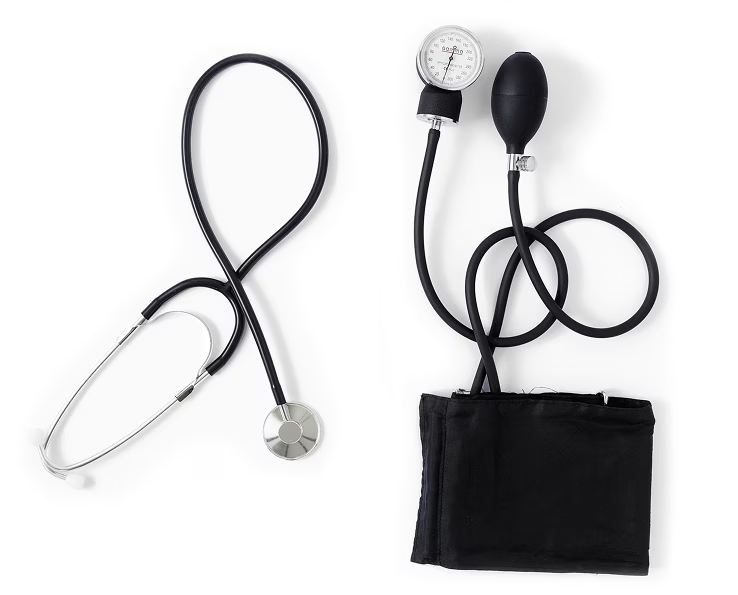
After passing the assessment, it is necessary to undergo a medical examination* as it is a prerequisite to starting your pilot training. If the aim is to obtain a Commercial Pilot License, a Class 1 medical certificate is required, whereas, for private pilot training, Class 2 is also acceptable.
* If you do not hold any license, your medical certificate has to be issued in Lithuania according to the Lithuanian CAA. You only need to validate your medical certificate in Lithuania if you already have a license.
Read more about medical examinationStart earning from €45,000/year now.