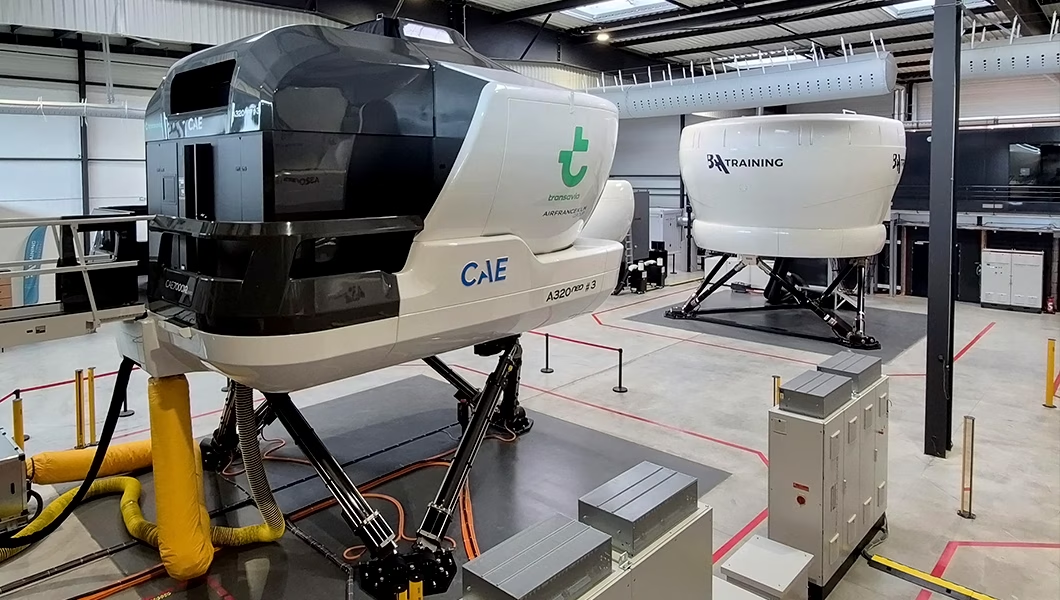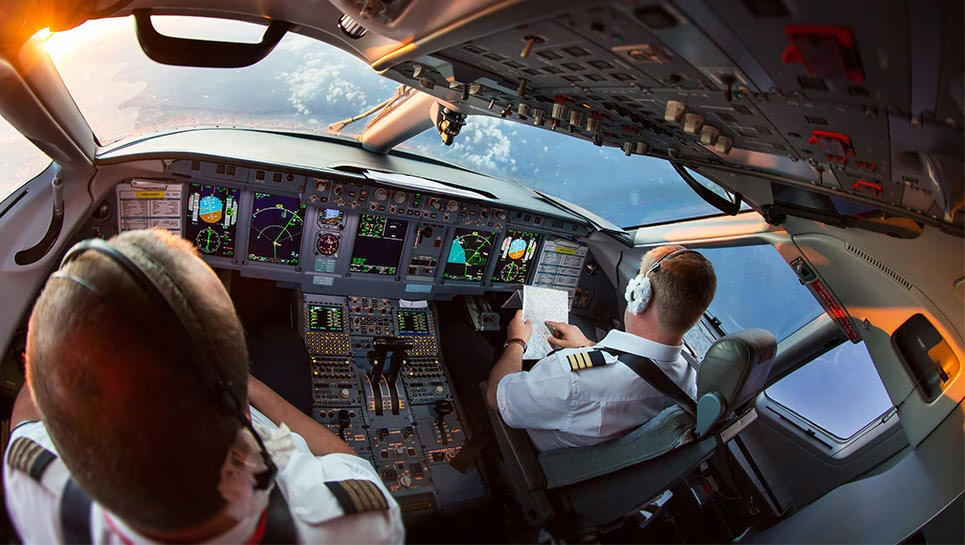
At the end of this year airline pilots will be required to undergo additional training. Commission Regulation (EU) introduced new requirements for upset prevention and recovery training (UPRT). All pilots studying for new ATPLs and pilots undergoing their first type rating course in multi-pilot operations, will be required to undergo the new Advanced UPRT course FCL.745.A. On-aircraft UPRT training will become mandatory by the end of this year, from the 20th of December 2019.
What is UPRT?
It is an acronym that stands for Upset Prevention Recovery and Training and constitutes a combination of theoretical knowledge and flying training with the aim of providing flight crew with the required competencies to both prevent and to recover from situations in which an aeroplane unintentionally exceeds normal flight parameters.
What factors might cause an upset? Let’s take thunderstorms as an example. All pilots, and the vast majority of the flying public, are well aware that thunderstorms are hazardous and should be avoided, but what precisely does that mean? At what proximity does a thunderstorm pose a danger and does that proximity alter depending on altitude as well as the distance from the take-off or landing airfield? What are the various hazards of a thunderstorm? What effect are they likely to have on the aircraft and where might these experienced? What are the most effective means of identifying thunderstorm cells and their hazards, including the use of systems and technology? When confronted by a thunderstorm from where is the most significant threat likely to be encountered? What might be the indications in the flight deck and how would a flight crew implement the best recovery techniques?
UPRT takes these specifics into account and expands upon them rather than the more general idea that thunderstorms are dangerous and should be avoided. UPRT deals far more specifically with the What, Where, When, Why and How.
According to BAA Training Deputy Head of Training Mauro Belloni the UPRT is a mandatory training and it should be implemented both by every airline for their pilots and for the pilot instructors. For the commercial pilots, this training is aircraft-type-related and shall be repeated every year.
UPRT is needed, particularly for professional pilots
Loss of control in flight is the single largest cause of commercial aircraft accidents and fatalities. As a result both the industry and regulators have recently focused on UPRT. A number of high-profile air transport catastrophes has made it evident that this type of training has not only been historically lacking but is also very much needed in order to better manage the risk of the re-occurrence of such events and their potentially lethal consequences.
There is no secret that training and repetition is the only way to develop a skill. So, if certain piloting skills are not trained and repeated, then it stands to reason that pilots may well be deficient in those areas.
Another important factor to consider is the frequency and time allowed for training. Air transport pilots are required to undergo recurrent training twice per year and on each occasion a total of four hours of simulator time is scheduled for two pilots: two hours for flying, two hours performing the duties of the pilot monitoring.
So, the maximum total training time whilst actually handling abnormal situations in the aircraft in a year is only four hours. Four hours, not accounting for numerous items which the vast majority of have nothing to do with recovering from an upset condition.
Two aspects of the training
The diversity of causes of an upset including Environmental, Systems and system malfunctions, Aerodynamic, Pilot induced / Human Factor or any myriad of combinations of the above, as well as other contingent factors, are covered in UPRT training. An emphasis is placed on prevention as it is obviously far more desirable to avoid an upset condition rather than have to recover from one. The primary goal of the training is to help ensure that pilots are well equipped to resolve an upset condition, both technically and emotionally.