How Well Pilots Are Equipped to Deal with Turbulence
The increasing number of reports about strong turbulence during flights has brought more general attention to the topic, with some raising a question of flight safety.
Content
Since air transportation is regarded as the safest mode of travel, pilots are responsible for ensuring the safety of the passengers on board. So, how well-equipped are they to deal with such weather conditions?
Turbulence is covered from the start
Pilot training is rigorous and requires a multitude of polished skills and abilities in order to become a competent pilot. Among the 14 subjects pilots cover during the theoretical part of their training at a ground school, Meteorology is the one that thoroughly explores everything to do with weather. In both flight training and personal life, meteorology is inevitably present, says Jose Manuel dos Reis Dias, Deputy Chief Theoretical Knowledge Instructor at BAA Training.
“Just like we are used to checking weather apps to see if we need to grab an umbrella, meteorology is an omnipresent subject in pilot training because the majority of the flights take place inside the troposphere, the lowest layer of the atmosphere, and also the most upset – turbulent – one.”
Dias emphasizes that during ground school, there is a lot of focus placed on turbulence. Out of the 66 hours of classroom lessons about meteorology, the theme of turbulence appears from the very beginning.
“Students cover the topic of wind, which includes phenomena like mountain waves and Clear Air Turbulence (CAT); turbulence associated with clouds, jet streams, and wind shear is covered in Flight Hazards and Meteorology Information teaches students to utilize methods in order to decode and use the information about turbulence, for example, CAT in the upper troposphere.”
Theory is applied in practice
After full training, pilots are well-prepared to deal with different types of weather and the levels of turbulence they might encounter.
Once students pass the theory examinations, the knowledge is then applied during flight school – the practical part of initial pilot training. Reading weather information and dissecting it to prepare for a smooth flight is a necessary part of the daily pilot responsibilities, explains Omar Noureldin, Deputy Chief Flight Instructor for Initial Pilot Training at BAA Training.
“Student pilots not only drill down the Standard Operation Procedures (SOPs) through repetition and practice during their initial training but also have a course dedicated to aircraft upset prevention and recovery. It refines a pilot’s proficiency in recognizing and mitigating potential aircraft upset scenarios and recovering control of an aircraft that has deviated from its normal flight envelope.”
Once pilots complete their aircraft-type-specific training, they are well-prepared to deal with different types of weather and the levels of turbulence they might encounter. While severe cases are still rather rare for actively flying pilots, the training always includes all possible scenarios so that they are ready to act if needed.
Subscribe to BAA Training
Steps dealing with turbulence
The probability of a pilot being caught unprepared in mid-air is a low one. Dias notes that a thorough pre-flight briefing – looking at all available and relevant meteorological information – is what allows for avoiding known and forecasted areas of turbulence.
“Virtually, severe turbulence can occur anywhere, but they are usually more frequent closest to the Inter Tropical Convergence Zone (ITCZ), where these phenomena are stronger,” he explains. “The most important thing to understand is that turbulence – of any kind – is still a hazard for flight. We teach our students with this mindset so that they are always prepared for turbulence and are ready to follow SOP if needed.”
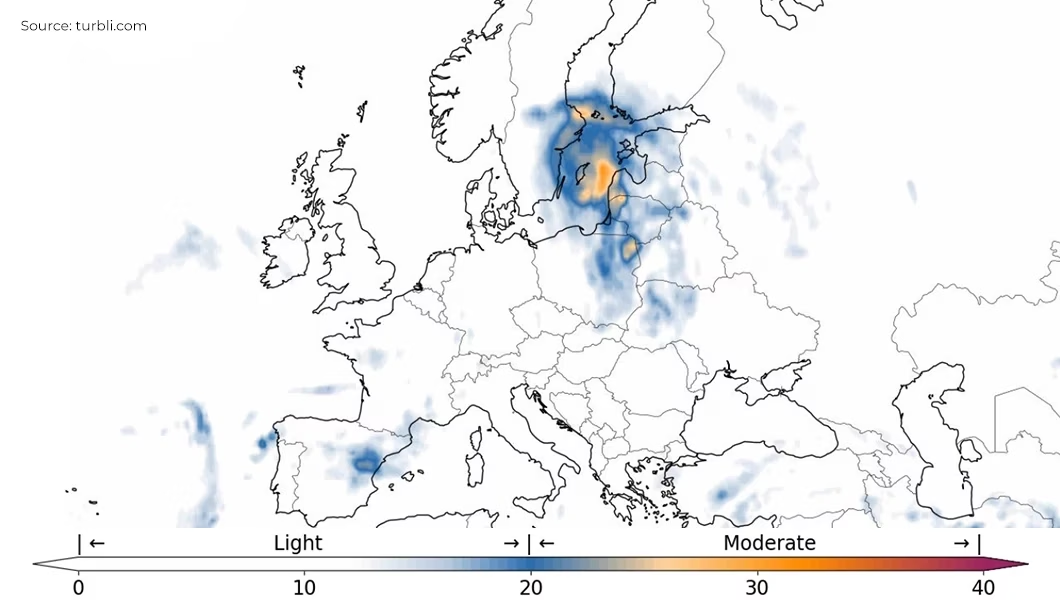
A weather map showing turbulence in Europe
Some of the key steps pilots take to prepare for turbulence, according to Noureldin, are rather straightforward.
“First, we avoid it if we can. This means pilots avoid flying close to mountains on windy days and avoid thunderstorms – which are the most aggressive weather conditions there are in aviation. Commercial aircraft are equipped with weather radars that help see thunderstorm activity, where pilots can expect strong turbulence. Other types of turbulence, like a thermal, jet stream, or wake, are not detected by the radar, but pilots are trained to predict and expect them by observing mountains, wind speeds, weather charts, and forecasts.”
If a pilot encounters turbulence, the first thing they do is slow down, elaborates Noureldin. Every aircraft is built to sustain turbulence and has a specific turbulence penetration speed set by the manufacturer.
“Pilots then try to get out of the affected area by changing direction or altitude if the turbulence persists longer or has a moderate severity,” he adds. “Human errors do exist in aviation, but we always make sure our students are capable of properly understanding the information and possessing the necessary skills to ensure a safe flight once they have their license.”
Bottom line
Pilots are extensively trained and well-equipped to handle turbulence, ensuring passenger safety even under challenging weather conditions.
From comprehensive theoretical studies in meteorology to rigorous practical training and scenario-based exercises, pilots develop a deep understanding of atmospheric phenomena and effective strategies for managing turbulence. The constant emphasis on safety procedures, pre-flight briefings, and the use of advanced technology like weather radars further enhance their preparedness. While turbulence can be an unavoidable aspect of air travel, rest assured that pilots are highly skilled in navigating through it, prioritizing safety and comfort on every flight.
Author: Karolina Zilenaite
With the background in journalistic writing, Karolina has years of content creation experience under her belt. Tackling all manner of topics across the aviation industry, she aims to bring interesting perspective and spark curiosity.
This website uses cookies. You can express your preference for cookies by selecting one of the options below. If you select the "Allow" option, you agree to the use of all types of cookies, including third party and marketing cookies. You can change your cookie settings or withdraw your consent at any time. Your consent is not required for the recording of the strictly necessary cookies. For more information, please read our
Cookie Policy.
Cookies settings
We use cookies and other similar technologies to help provide our Services, to advertise to you and to analyse how you use our Services and whether advertisements are being viewed. We also allow third parties to use tracking technologies for similar purposes. If you are using our Services via a browser you can restrict, block or remove cookies through your web browser settings.