
But what exactly happens when one occurs mid-flight and a pilot needs to declare emergency? How do pilots and Air Traffic Control (ATC) work together to ensure the safety of everyone on board?
In this article, we’ll explore the crucial communication and procedures that come into play when an aircraft declares an emergency. Previously, we covered the basics of understanding the ATC lingo and some key dialogue examples for standard flights. This is the third – and final – installment of our series on communicating with Air Traffic Control, and we’ll be delving into what qualifies as an emergency, the specific steps pilots and ATC controllers take, the key phrases used during these critical moments, and more. Let’s dive into the heart of aviation safety and explore how these professionals manage the unexpected with calm and precision.
What is considered an emergency during the flight?
In aviation, an emergency is any situation that significantly threatens the aircraft’s and its occupants’ safety. These emergencies can include anything from mechanical failures and medical emergencies to severe weather and security issues. When such a situation arises, the pilot’s top priority is to ensure the safety of everyone on board and to communicate effectively with Air Traffic Control.
Emergencies are classified into two main categories: distress and urgency.
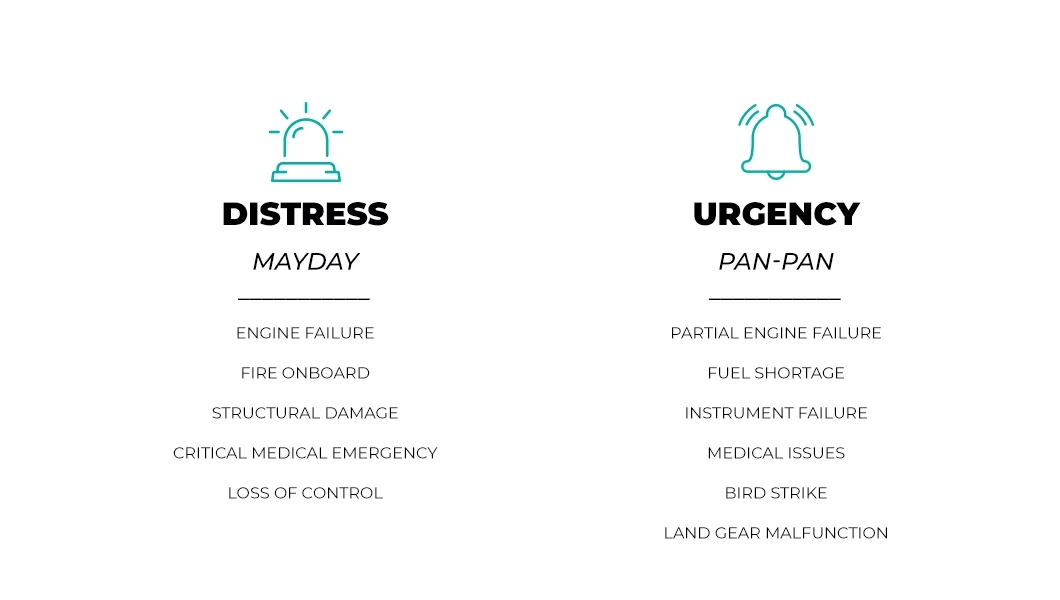 There are two main types of emergencies: distress and urgency.
Distress (Mayday)
A distress situation, signaled by the word “Mayday,” is the most serious type of emergency. It indicates that the aircraft is in immediate and grave danger, requiring urgent assistance. Here are some examples of situations that would warrant a Mayday call:
- Engine Failure: If an aircraft experiences a complete engine failure or multiple engine failures, especially in critical phases of flight like takeoff or landing, the pilot would declare a Mayday. This scenario presents an immediate threat to the aircraft’s ability to stay airborne.
- Fire Onboard: The presence of smoke or fire inside the cabin or cockpit is a severe emergency, as it can quickly incapacitate the crew and damage the aircraft. A Mayday would be declared to prioritize a swift landing.
- Structural Damage: Significant structural damage, such as a loss of control surfaces (e.g., rudder, aileron) or a cracked windshield at high altitude, would also result in a Mayday. Such damage could compromise the aircraft’s integrity and controllability.
- Critical Medical Emergency: If a passenger or crew member suffers a life-threatening medical emergency, such as a heart attack or stroke, and immediate medical attention is required, the pilot may declare a Mayday to expedite landing at the nearest suitable airport.
- Loss of Control: Situations, where the pilot loses control of the aircraft due to severe turbulence, system failure, or other reasons, could prompt a Mayday call. This signals an urgent need for assistance in stabilizing the situation or executing an emergency landing.
Urgency (Pan-Pan)
An urgency situation, indicated by the phrase “Pan-Pan,” while serious, does not pose an immediate threat to the aircraft’s safety. However, it still requires prompt attention to prevent the situation from escalating. Here are some examples of situations that would fall under urgency:
- Partial Engine Failure: If an aircraft experiences a partial engine failure, such as losing thrust in one engine while the other remains operational, the pilot might declare a Pan-Pan. The situation is critical but not as immediately dangerous as a total engine failure.
- Fuel Shortage: If an aircraft is running low on fuel and is unlikely to reach its intended destination but still has enough fuel to land safely at an alternative airport, the pilot would use Pan-Pan to communicate the urgency of the situation.
- Instrument Failure: A failure of key instruments, such as the altimeter or navigation systems, could lead to a Pan-Pan declaration. While the aircraft remains controllable, the loss of critical instruments can complicate navigation and landing, especially in poor weather.
- Medical Issues: If a passenger or crew member falls seriously ill, but the situation is not immediately life-threatening, the pilot might declare a Pan-Pan to request a diversion to the nearest airport with adequate medical facilities.
- Bird Strike: If an aircraft suffers a bird strike that causes damage but does not immediately threaten the safety of the flight, the pilot might declare a Pan-Pan. The urgency reflects the need for inspection and potential maintenance before continuing the flight.
- Landing Gear Malfunction: If the landing gear fails to deploy fully but remains partially functional, the pilot might declare a Pan-Pan, indicating that the situation is serious but not immediately catastrophic.
These terms are internationally recognized, including throughout European airspace, and the type of emergency declared informs the response actions taken by both the pilot and ATC.
Procedures pilots follow when declaring an emergency
 Three words that guide a pilot during an emergency: Aviate, Navigate, Communicate.
In an emergency, pilots adhere to specific procedures, often remembered by the acronym ANC – Aviate, Navigate, Communicate:
- Aviate: The pilot’s first duty is to keep the aircraft under control. Without maintaining control, no other actions are possible or relevant.
- Navigate: The next step is to ensure the aircraft is on a safe flight path. This might involve diverting from the planned route, descending to a safer altitude, or preparing for an emergency landing.
- Communicate: Once control and navigation are secured, the pilot must communicate the situation to ATC, declaring the emergency and providing critical details such as the nature of the problem, current position, altitude, and intentions.
 To manage emergencies, both pilots and Air Traffic Controllers go through comprehensive training.