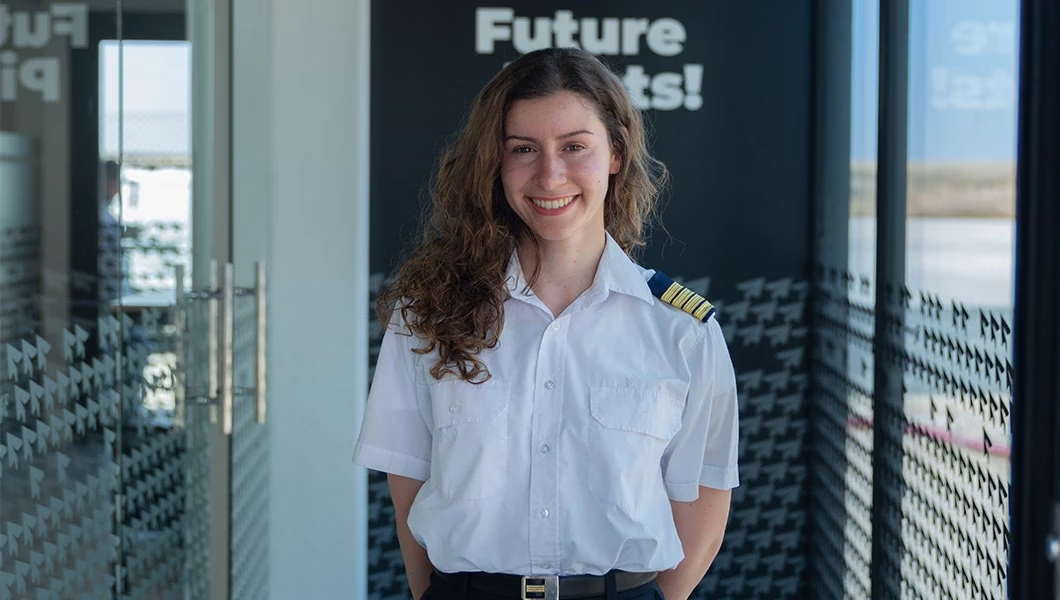
Our Flight Instructor (FI) Raquel Portugues’ story is one of the latter, shaped by proximity, patience, and an unwavering sense of belonging that would eventually lead her to BAA Training’s cockpits.
When the Sky Becomes Home
High school brought the pressure of choosing a path forward, and with it, the kind of uncertainty that many teenagers face. But living near an airport gave Raquel something most don’t have: a daily reminder written across the sky. While other students struggled with university brochures and career aptitude tests, she was looking up.
“I was living near an airport, so a lot of times I was looking up in the sky, with this kind of certainty. I kept seeing the planes all around, and it made me feel a sense of belonging. And it just clicked for me. And I just thought – I want to be a pilot.”
That moment was decisive. Raquel enrolled in a flight school immediately after graduation, starting flying small aircraft. No hesitation, just the beginning of what would become a career in aviation. Some people spend years searching for their calling. Hers flew overhead every day.
From Student to Role Model
A few years into her flying journey, Raquel began to see her career from a different altitude. The student pilot who once meticulously prepared for her first solo flight, now had something valuable to pass on. But the decision to become an instructor wasn’t driven by a desire to move up a ladder. It was about remembering who helped her climb it in the first place.
Raquel’s own instructors had shaped not just her skills, but her entire approach to aviation. They were the ones who turned anxiety into confidence, confusion into clarity. Now, she wanted to be that person for someone else.
“I would always think, when I was still at the flight school, how well my instructors guided me, and that actually inspired me to become a role model to others. And I feel that instructors are those who set strong foundations for today’s pilots.”
But instructing also offered something she didn’t expect – to keep learning. The young pilots Raquel now trains ask questions that make her reconsider things she thought she knew. They challenge assumptions, bring fresh perspectives, and remind her why she fell in love with flying in the first place. Teaching, it turns out, is a reciprocal education.
Discipline That Carries You Through
If you ask Raquel what single quality will determine whether a student pilot succeeds or washes out, she won’t say natural talent or passion. She’ll say discipline – and she means it in the least romantic sense possible.
Flight training isn’t just a series of exhilarating moments punctuated by the occasional textbook. It’s months of dense study, procedural memorization, and repetitive practice that can feel, at times, like an obstacle course designed to test your patience. The students who make it are the ones who accept that reality rather than resist it.
“It is going to be a rough ride, especially in the beginning. It’s a lot of studying. It can be a bit of an obstacle, or feel like one, so it’s very important that you have strict discipline with yourself. There’s not really a lot of time for procrastination.”
This isn’t advice Raquel pulled from a manual. It’s the lesson learned firsthand by many pilots-in-training who wonder if they’d made the right choice. Discipline, Raquel discovered, isn’t about being hard on yourself. Committing fully to what’s in front of you, even when it’s difficult, that’s what’s really behind it. Especially when it’s difficult.