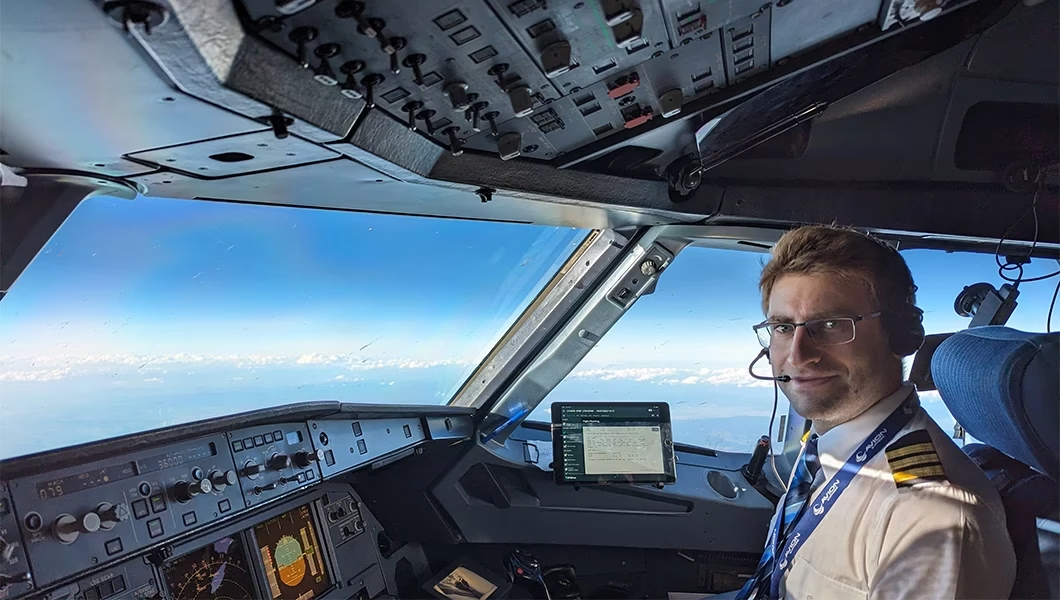
So, we are releasing this article to reveal the most crucial things about us as an organization. To give you an idea of the honest view and objective opinion of someone with first-hand experience, we have asked our former student Oscar Bertrand to answer these questions.
Oscar has finished the Avion Express cadet program at BAA Training and is now a First Officer at Avion Express, a leading Charter and ACMI company.
Entry Requirements
• What are the requirements for enrolling in a pilot training program?
The minimum age is 18 years old. The cadet program is Ab Initio, thus no flight experience is required. However, having previous experience, whether on light aircraft, gliders, or ultralights, is a strong and valuable demonstration of interest and commitment. Do not underestimate experience with gliders; it is very good training, and I encourage everyone to start with this kind of experience. Also, a sound understanding of physics, aerodynamics, meteorology, etc., is a must-have.
Training Program Basics
• Can I work part-time during pilot training, or is it a full-time commitment?
It is definitely a full-time investment. However, I know some people who had a job at the same time and somehow managed to deal with both activities. But I strongly do not recommend it at all.
• Are there any specific medical requirements to become a commercial pilot?
Yes, depending on your age, a 1st class medical license has to be renewed at least every year. Having a good lifestyle is the best chance to keep your medical license current.
• How is the training structured?
It basically starts with a theory, 14 ATPL subjects their respective exams. Once you pass your first exam, you have 18 months to finish them all. The theory part takes around 7-9 months, depending on the individual.
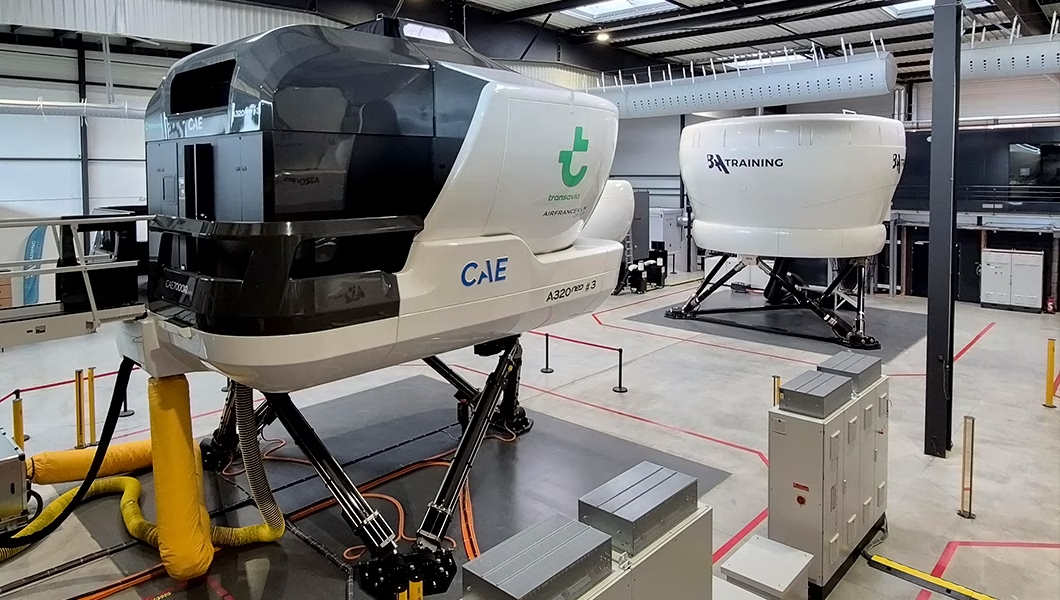
Afterwards, you begin the first flying lessons, starting with VFR flights, learning the basic stuff about flying an aircraft and navigating, together with radio communication. Finally, IFR training on more performant aircraft, firstly on single-engine and then on multi-engine aircraft. That’s the most amazing part, flying at a high altitude with amazing sight over Spain! MCC (A320/B737) that ends the Ab Initio training up is done on an FFS simulator. Last but not least, you are going to start your Type Rating and Base training, the costs being included in the cadet program.
• How good do I have to be at Maths and Physics to pass the assessment?
It is not rocket science, but you need to have a good understanding of physics with a minimum scientific mindset. It doesn’t mean you NEED to have a degree in this area (I know a lot of people coming from very different areas such as cinema, finance, etc.), but a scientific culture and understanding are a must. Flying an aircraft is all about science and physics, after all!
• What is the pass rate for licensing exams? What if I don’t pass on the first attempt?
For the ATPL exams, all you need is to pass all 14 exams in 6 sessions. Should you fail one exam, it will be postponed to the next session. But never forget about the hard limit of 6 sessions. Failing one exam is not a big deal; just be aware of the 6 session limit. During flight training, you will have some intermediate exams in order to move to the next stage. Should you fail it, you will need to pay for some extra sessions.
Tuition Assistance
• How does one handle the financial aspect? Where can one get financial assistance to pay for pilot training?
I had a student loan from my bank; contact your bank for more information. Not all banks have the same terms and conditions to apply for a student loan.
Also, be patient. It took me a lot of time to save money before starting the training. Doing my engineering school in apprenticeship helped me save money, and I worked as a full-time engineer afterward for 2 years. Overall, it took me 6 years to be comfortable enough financially speaking.
In the meantime, build some flight hours in order to consolidate your interest in aviation. It is worth mentioning that flight hours on gliders are much, much cheaper than on general aviation aircraft. Go for it!
• Is there accommodation available nearby?
Lithuania and Spain are both quite affordable when it comes to accommodation, and finding a place is not too difficult. In Lithuania, people are quite international, making it easy to find English-speaking landlords.
Training Facilities, Aircraft, and Other Equipment
• What type of aircraft do students typically train on?
BAA Training students fly on C-172 G1000 (IFR) and Tecnam P2006 (multi-engine).
• Apart from aircraft, what other equipment is used in training?
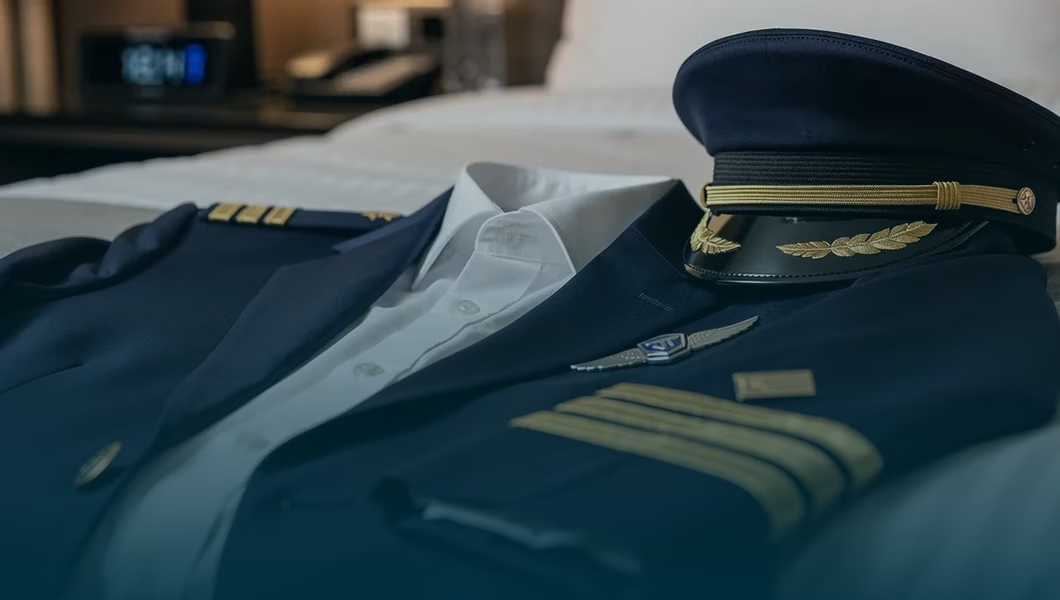
All the necessary equipment will be provided (including a uniform). Take a basic calculator for the theory. BAA Training also uses an FNPTII trainer (for a smooth transition from VFR to IFR) and FFS (for MCC and Type Rating).