1984 is the year to remember. Every Airbus fan knows the day when the Airbus A320 was launched. Air France was the first Airbus customer to operate this type of aircraft in 1988. A320 family aircraft fly on every continent and it is often a top-choice around the globe from low-cost carriers to full-service airlines due to its flexibility. A320 can take passengers probably anywhere – from short runway urban environments to remote high-altitude airports. Airbus A320 became one of the leading aircraft due to several reasons and one of them is related to the high adoption of advanced solutions.
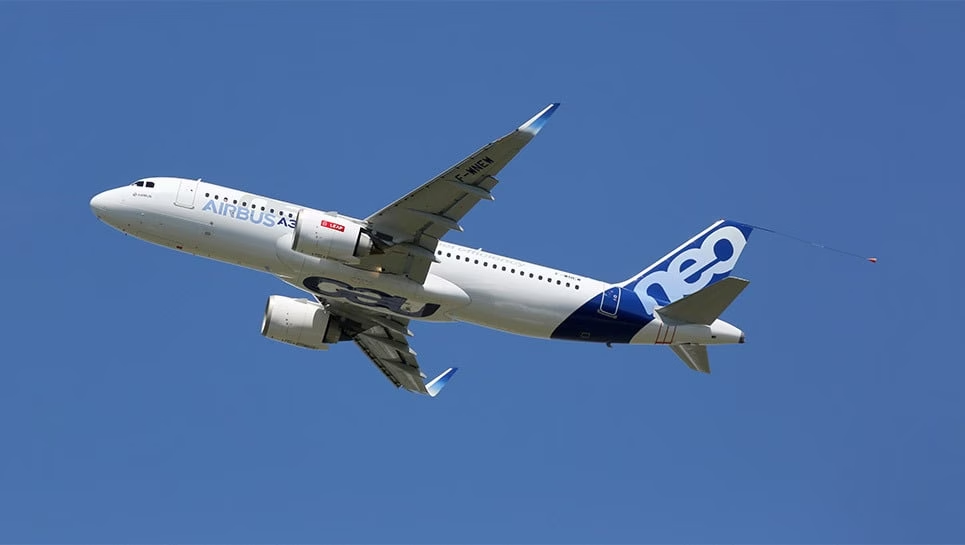
At the moment Airbus offers two versions of the A320 – the original A320ceo and the next A320neo. The ‘ceo’ is older and it stands for the ‘current engine option’ and the ‘neo’ is the ‘new engine option’. What are the differences between these two aircraft types? Did Airbus redesign the aircraft for the next generation? Let’s take a closer look.
Differences
Airbus launched A320neo on 1 December 2010. The first A320neo rolled out of the Airbus factory in Toulouse on 1 July 2014 and it made the first flight on 25 September 2014. Afterwards it entered service in 2016 when introduced to the first client Lufthansa. Moreover, the original A320 family has been renamed A320ceo. A320neo used several technological advancements delivered by Airbus’ continuing commitment and investment in the most successful aircraft family of all time. What are these aircraft developments?
New engine. The ‘neo’ come for the new engine option which is the major improvement of the aircraft. It was created to bring more value to the airline – to be more fuel-efficient, quieter and can fly a longer distance. According to Airbus, its update help maintain its A320 product line’s position as the world’s most advanced and fuel-efficient single-aisle aircraft family. The baseline A320neo jetliner has a choice of two new-generation engines (the PurePower PW1100G-JM from Pratt and Whitney and the LEAP-1A from CFM International). New engine saves more fuel and is able to carry more fuel, which means ability to fly longer flights.
Sharklets. The Airbus A320neo was launched with changes on the aircraft exterior to increase its performance. Originally, Airbus came with small triangle wingtips, which functionally worked but increased drag. Looking for neo’s performance improvement the aircraft manufacturer added a big curved wingtip called a ‘sharklet’. Although the installation of ‘sharklets’ adds 200kgs to the aircraft weight, the wing area is increased generating more lift. This also creates a smaller wingtip vortex, thanks to less lift-induced drag. Overall, there is a reduction in fuel burn (up to 3 percent) and a small climb performance boost.
Cabin updates. Moreover, Airbus improved aircraft cabin too – modern seating was designed for greater passenger comfort. It comes together with better pressurization, larger luggage space, noise reduction, LED lighting, and modern seating design for greater passenger comfort.